


 PLATFORM UPDATE:


Sequence-specific fluorescence turn-on arises from base pairing-templated tautomerism in the tricyclic cytidine analogue DEAtC
 a
and
Byron W.
Purse
*a
a
and
Byron W.
Purse
*a
Abstract
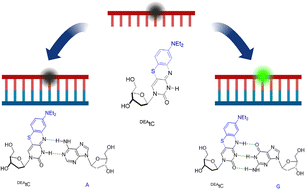
Fluorescent probes for measuring the structure, dynamics, cellular localization, and biochemistry of DNA and RNA are useful for determining the regulatory mechanisms of gene expression. Intrinsically fluorescent, Watson–Crick-capable nucleobase analogues are especially powerful because they can precisely probe desired loci while minimally perturbing native nucleic acid function. Here, we study the fluorescent responses of the tricyclic pyrimidine analogue DEAtC to base pairing with adenine, guanine, and a set of noncanonical nucleobases in duplex DNA oligonucleotides. We find that single-stranded oligonucleotides containing one DEAtC exhibit up to a fivefold fluorescence increase upon hybrid duplex formation and base pairing with G, and a lesser degree of fluorescence turn-on when base pairing with inosine. Other purine nucleobases do not induce significant fluorescence turn-on. Solvent kinetic isotope effect measurements, excitation–emission matrix (EEM) analysis, and spectral comparisons indicate that fluorescence turn-on originates from base pairing-templated tautomerism. The non-emissive T-like form predominates in the single strand and in duplexes paired with A, whereas the emissive C-like tautomer is selectively stabilized upon duplex formation when paired with G. Density functional theory (DFT) calculations further support this tautomeric control model. Although base stacking influences overall brightness, it does not alter the mechanism or specificity of fluorescence turn-on. Modulation of emission through tautomeric control offers a powerful strategy for designing nucleobase analogues with base pairing-specific fluorescence responses.
 Please wait while we load your content...


