


 PLATFORM UPDATE:


High-resolution structure of proIAPP(1–48) fibrils suggests a mechanistic pathway for diabetes-associated IAPP fibril polymorphs
 a
and
Michał
Maj
*a
a
and
Michał
Maj
*a
Abstract
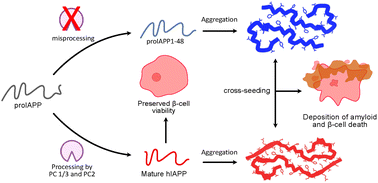
The human islet amyloid polypeptide (hIAPP) aggregates into amyloid fibrils that contribute to β-cell failure in type 2 diabetes. hIAPP is produced from a 67-residue precursor, proIAPP, but incomplete cleavage by prohormone convertase 2 (PC2) produces the 48-residue intermediate proIAPP(1–48), which accelerates amyloid formation in vivo. Here we show that proIAPP(1–48) assembles almost exclusively into a single fibril polymorph. Using cryo-electron microscopy we solved its structure at 3.5 Å resolution and uncovered a P-shaped, C2-symmetric dimer whose backbone and side-chain packing are nearly identical to the disease-associated TW2 polymorph propagated from pancreatic tissue, although with different helical symmetry. All eleven extra N-terminal residues remain disordered but create a weak density around His29. Based on time-averaged density derived from molecular dynamics (MD) simulations, we identified multiple hydrogen(H)-bonding interactions, which may contribute to stabilising the TW2-like fold and explain the peripheral cryo-EM density. These data establish a structural link between defective proIAPP processing and the polymorphic spectrum of islet amyloid and suggest a seeding pathway by which proIAPP(1–48) templates pathogenic architectures that fully processed hIAPP rarely adopts in vitro.
 Please wait while we load your content...


