


 PLATFORM UPDATE:

Discovery of natural products that modulate signaling in patient-derived cells
 †a
Hannah L.
Thirman,
†bcf
Kathryn E.
Penton,
d
Jordan T.
Froese,
e
Benjamin J.
Reisman,
b
Sierra M.
Lima,
c
Madeline J.
Grider-Hayes,
cf
Chad R.
Potts,
gh
Jonathan M.
Irish,
cfg
P.
Brent Ferrell
gh
and
Brian O.
Bachmann
*abc
†a
Hannah L.
Thirman,
†bcf
Kathryn E.
Penton,
d
Jordan T.
Froese,
e
Benjamin J.
Reisman,
b
Sierra M.
Lima,
c
Madeline J.
Grider-Hayes,
cf
Chad R.
Potts,
gh
Jonathan M.
Irish,
cfg
P.
Brent Ferrell
gh
and
Brian O.
Bachmann
*abc
Abstract
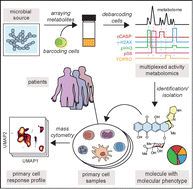
Natural products derived from biosynthetically apt microorganisms represent an important source for chemotherapeutic agents founded first via non-specific, cytotoxicity-guided isolation, then investigated for translational potential. Analyzing biosynthetic gene clusters within microbes predicts significant untapped potential of undiscovered therapeutically relevant natural products; however, stimulating biosynthesis of such compounds in sufficient quantities for isolation, structure determination, and biological assessment remains a gap. We address this with a bioactivity discovery pipeline that first utilizes Multiplexed Activity Profiling to identify stimulus-dependent induction of bioactive secondary metabolites via functional responses in human leukemia cell lines measured with fluorescence flow cytometry. Next, active extracts are analyzed via Multiplexed Activity Metabolomics, which correlates single cell assays with spectrally defined chromatographic arrays to identify bioactive metabolomic features prior to isolation. Two experimental case studies using this workflow with cave-microbe extracts identified new molecular phenotypes of the pyridine-pyrrolidine alkaloid siderochelin and the pyrrolopyrrole-functionalized anthracycline isoquinocycline B. Finally, we investigated the effects of anthracycline functionalization on human primary cells using single cell mass cytometry to understand if changes in anthracycline aglycon structure and glycosylation impacted cell selectivity. Despite sharing an anthracyclinone pharmacophore core, variants differentially impacted responses of leukemia cell populations within and among acute myeloid leukemia (AML) patient samples. This suggests pharmacophore assumptions may not guide assessment of therapeutic potential for anthracyclines and that modest structural differences can elicit marked changes in cellular function in different patients. Taken together, the depth of information afforded by single cell molecular phenotype-based discovery and mass cytometry deep cell profiling provides new patient-level insight into biological mechanisms of new and previously discovered molecules that may find expanded use in the clinic.
 Please wait while we load your content...


