


 PLATFORM UPDATE:


Covalent fragment screening to inhibit the E3 ligase activity of bacterial NEL enzymes SspH1 and SspH2
 a
Jane
Dudley-Fraser,
a
Diego
Esposito,
a
William J.
McCarthy,
a
Jacob
Bush,
c
David
House
*c
and
Katrin
Rittinger
*a
a
Jane
Dudley-Fraser,
a
Diego
Esposito,
a
William J.
McCarthy,
a
Jacob
Bush,
c
David
House
*c
and
Katrin
Rittinger
*a
Abstract
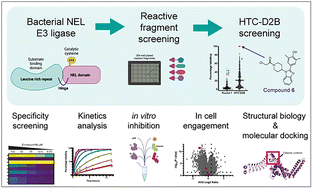
As the global fight against antimicrobial resistance in bacteria becomes increasingly pressing, new tool compounds are needed to study and evaluate novel therapeutic targets. Here, cysteine-directed fragment-based drug discovery is coupled with high throughput chemistry direct-to-biology screening to target the catalytic cysteine of a family of bacterial effector proteins, the novel E3 ligases (NELs) from Salmonella and Shigella. These effector E3 ligases are attractive as potential drug targets because they are delivered into host cells during infection, have no human homologues and disrupt host immune response to infection. We successfully identify hit compounds against the SspH subfamily of NELs from Salmonella and show that these proteins are inhibited by compound treatment, representing an exciting starting point for development into specific and potent tool compounds.
- This article is part of the themed collection: Celebrating International Women’s day 2026: Women in Chemical Biology
 Please wait while we load your content...


