


 PLATFORM UPDATE:

Tuning the efficiency of molecular probes via quinone methide-based in situ labeling
 †a
Seyedehalaleh
Anvar,
†a
Zixin
Chen,
a
Yuzhao
Zhang,
a
Ashton
Sigler
b
and
Lina
Cui
*ab
†a
Seyedehalaleh
Anvar,
†a
Zixin
Chen,
a
Yuzhao
Zhang,
a
Ashton
Sigler
b
and
Lina
Cui
*ab
Abstract
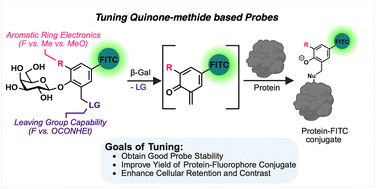
Imaging the activities of hydrolases using molecular imaging probes can reveal underlying molecular mechanisms in the context of cells to organisms and their correlation with different pathological conditions can be used in diagnosis. Due to the nature of hydrolases, substrate-based probes can take advantage of their catalytic cycles to free reporter moieties that can generate amplified signal. This is less ideal in the context of cell- or organism-based detection, as the reporter moiety can easily diffuse away from the target site upon activation. Therefore, spatial resolution is a key factor for probe sensitivity. One strategy to improve the spatial resolution is to form a covalent linkage between the reporter moiety and intracellular proteins upon probe activation by the enzyme via a reactive intermediate. In this work, we tuned the reactivity of the quinone methide intermediate by synthesizing fluorescent probes containing different modifications to the phenol linker for β-galactosidase activation. The labeling efficacy of these probes was evaluated using fluorescence gel electrophoresis, flow cytometry, and fluorescence cell imaging. This study provides insights into the further development of hydrolase-targeting probes for cell- or organism-based imaging with enhanced efficiency via in situ labeling.
- This article is part of the themed collection: Chemical Glycobiology: innovative tools for the sweet side of biology
 Please wait while we load your content...


