


 PLATFORM UPDATE:


RNA-binding fluorogenic probes: G-clamp conjugated with a thiazole orange derivative for screening RNA-binding small molecules
 ab
Kazumitsu
Onizuka,
*abc
Kaoru R.
Komatsu,
de
Hirotaka
Murase,
a
Hirohide
Saito
df
and
Fumi
Nagatsugi
*ab
ab
Kazumitsu
Onizuka,
*abc
Kaoru R.
Komatsu,
de
Hirotaka
Murase,
a
Hirohide
Saito
df
and
Fumi
Nagatsugi
*ab
Abstract
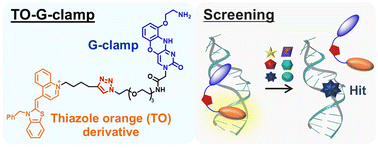
RNA has emerged as an attractive target for drug discovery, increasing the importance of methods for identifying RNA-binding small molecules. Fluorescent indicator displacement (FID) assays are commonly used for screening such molecules. However, because fluorescent indicators detect hit compounds through competitive binding, developing a diverse range of indicators is essential to avoid missing potential hits. Here, we introduce novel RNA-binding fluorogenic molecular probes for FID assays by conjugating thiazole orange (TO) derivatives to the unique RNA-binding molecule G-clamp, resulting in TO-G-clamp. G-clamp was chosen for its distinct RNA-binding mode compared to TO derivatives, as demonstrated by their large-scale RNA-binding profiles. Four TO-G-clamp analogs were synthesized and evaluated, all retaining the broad RNA-binding selectivity of G-clamp. Among them, TO-G-clamp-Bn, which features a benzyl substituent on the TO moiety, exhibited the highest consistency with the RNA-binding selectivity of G-clamp. FID assays using TO-G-clamp-Bn identified unique hit compounds that were insensitive to the well-known indicator TO-PRO-1. Furthermore, SHAPE-MaP analysis revealed the RNA-binding sites of TO-G-clamp, TO-PRO-1, and one of the hit compounds, AZ191, showing that the binding sites of TO-G-clamp were in close proximity to those of AZ191.
- This article is part of the themed collection: Celebrating International Women’s day 2026: Women in Chemical Biology
 Please wait while we load your content...


