


 PLATFORM UPDATE:


Tumor-confined delivery via syringeable hydrogels for reinforced immunomodulatory intervention

Abstract
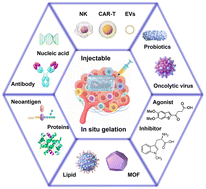
Syringeable hydrogels have emerged as transformative tools for precise drug delivery and controlled release, capitalizing on their exceptional injectability, shape adaptability, and localized retention. This review provides an overview of the recent advancements in hydrogel-based cargo delivery systems, focusing on injectable hydrogelators with immunomodulatory functions. Design principles tailored to optimizing the gelification process are presented, compared, and discussed following detailed structural analysis, with an emphasis on hydrogel formation mechanisms and biointeractions. Next, we summarize key applications, including adoptive cell therapy, catalytic immunotherapy, cancer vaccination, proteolysis-targeting chimeras, and immunometabolic intervention. To achieve a high therapeutic index while minimizing systemic side effects, the underlying mechanisms governing the spatiotemporal release of immunomodulators are presented as well. Finally, this review systematically discusses the persistent obstacles concerning manufacturing, biological safety, and clinical translation of these regulatory frameworks.
 Please wait while we load your content...


