


 PLATFORM UPDATE:


Multiscale design strategies for high-performance hemostatic bioadhesives
 *abc
*abc
Abstract
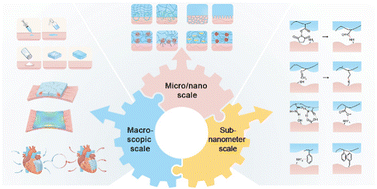
Uncontrolled hemorrhage remains a leading cause of mortality in trauma and surgery. Traditional mechanical closures, such as sutures and staples inevitably cause secondary tissue damage and often fail to achieve robust sealing on dynamic, wet wounds. While bioadhesives represent a promising alternative, their performance in the complex in vivo hemorrhagic environment is severely compromised by factors including tissue heterogeneity, hemodynamic washout, organ motion, and interfacial hydration. There is a lack of a systematic framework integrating cross-scale design strategies. This review presents multiscale design strategies for hemostatic bioadhesives tailored to complex internal bleeding scenarios: at the macroscopic scale, it emphasizes adapting material forms and mechanical properties to specific wound geometries; at the micro/nanoscale, it elucidates how structural strategies enhance energy dissipation and adhesion strength; and at the sub-nanometer scale, it categorizes bonding modes of covalent and non-covalent interactions. Through representative case studies, we demonstrate how multiscale integration achieves synergistic functionalities beyond the reach of single scale optimization. This hierarchical framework provides a rational roadmap for the development of next-generation high-performance hemostatic bioadhesives.
 Please wait while we load your content...


