


 PLATFORM UPDATE:


Thermoresponsive hydrogels for controlled drug delivery to the back of the eye: a data-driven guide to formulation design
 a
and
Vibhuti
Agrahari
*a
a
and
Vibhuti
Agrahari
*a
Abstract
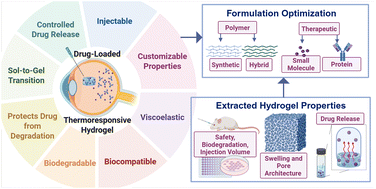
Hydrogels are water-rich, biocompatible three-dimensional polymer networks widely recognized for their ability to control drug release at specific target sites. Among them, in situ forming thermoresponsive hydrogels have emerged as promising injectable platforms for long-acting drug delivery to the posterior segment of the eye. These systems can reduce injection frequency, improve patient adherence, and minimize complications associated with repeated intravitreal dosing. However, the absence of standardized formulation and evaluation methodologies limits clinical translation. This study provides a comprehensive overview of drug-loaded, thermoresponsive hydrogels designed for intravitreal administration. It examines the influence of polymer composition and therapeutic class on key hydrogel properties, including mechanical behavior, safety, and drug-release performance, based on qualitative and quantitative analyses of 35 preclinical studies. Special attention is given to systems achieving prolonged drug release while maintaining biodegradability and biocompatibility. The findings consolidate current evidence and offer guidance for rational formulation design, highlighting how polymer structure and physicochemical characteristics can be tuned to optimize sustained ocular drug delivery and advance translation toward long-acting treatment of posterior segment diseases.
- This article is part of the themed collection: Biomaterials Science Open Access Spotlight
 Please wait while we load your content...


