


 PLATFORM UPDATE:


A thermosensitive hydrogel achieves sustained co-delivery of two therapeutic agents with distinct properties for preventing aseptic loosening

Abstract
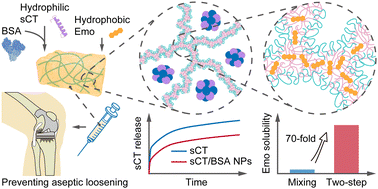
Wear particle-induced prosthesis aseptic loosening severely affects the longevity of total joint arthroplasty. This condition arises from periprosthetic osteolysis, which is driven by excessive inflammation and enhanced bone resorption under particle stimulation. Herein, we develop an injectable hydrogel-based system co-encapsulating anti-inflammatory emodin (Emo) and anti-osteoporotic salmon calcitonin (sCT) to synergistically inhibit wear particle-induced aseptic loosening. This hydrogel is formulated from thermosensitive poly(lactic acid-co-glycolic acid)-b-poly(ethylene glycol)-b-poly(lactic acid-co-glycolic acid) triblock copolymers and water. The aqueous system undergoes a sol-to-gel phase transition upon heating with the transition temperature between room temperature and body temperature. Highly hydrophobic Emo is efficiently solubilized into micelles formed by the amphiphilic carrier polymers, while hydrophilic sCT is encapsulated within bovine serum albumin (BSA)-derived nanoparticles to suppress its initial burst release and prolong its release duration from the hydrogel matrix. This dual-delivery platform achieves simultaneous and continuous liberation of both therapeutic agents with distinct properties. In a mouse bone-implanted air pouch model, a single administration of the hydrogel formulation plus the sustained release of active Emo and sCT efficiently suppresses titanium particle-induced aseptic inflammation and osteolysis. Therefore, this local and long-acting co-delivery system holds great promise for preventing wear particle-induced aseptic loosening.
- This article is part of the themed collection: Biomaterials Science Open Access Spotlight
 Please wait while we load your content...


