


 PLATFORM UPDATE:


Engineering immune-evasive islet replacement: cell-intrinsic and peri-graft strategies
 †b
and
Jinah
Jang
*bcde
†b
and
Jinah
Jang
*bcde
Abstract
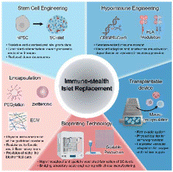
Islet transplantation offers a physiological approach for restoring endogenous insulin secretion in type 1 diabetes, yet its broad clinical application remains constrained by donor scarcity, immune-mediated rejection, and limited graft durability. Stem cell-derived islets have emerged as a scalable alternative, supported by recent clinical progress, but long-term therapeutic efficacy remains challenged by incomplete maturation, immune incompatibility, and persistent immune-mediated injury after transplantation. Early efforts to mitigate immune rejection relied on physical immunoisolation strategies, including micro- and macroencapsulation, to limit immune cell access to transplanted grafts. However, incomplete protection from soluble inflammatory mediators and diffusion-related constraints highlighted the need for more direct immune modulation. In response, substantial efforts have focused on engineering immune-evasive islets through a spectrum of cell-intrinsic strategies, ranging from permanent genome engineering to transient gene silencing and immune signal programming. Among them, clustered regularly interspaced short palindromic repeats (CRISPR)-Cas9-based genome editing has emerged as a central platform, enabling precise modification of immune-related pathways that reduce immune recognition and inflammatory signaling. In parallel, advances in biomaterials and biofabrication have enabled regulation of the peri-graft physicochemical milieu, referring to the local graft microenvironment that governs immune exposure, mass transport, and mechanical constraints while supporting scalable manufacturing. Increasing evidence indicates that neither genetic immune modulation nor extrinsic microenvironmental control alone is sufficient to ensure durable graft function. This review highlights convergent design principles that integrate immune evasion, peri-graft milieu regulation, and manufacturability to advance clinically deployable islet replacement therapies.
- This article is part of the themed collections: Biomaterials Science Open Access Spotlight and Biomaterials Science Emerging Investigator Series
 Please wait while we load your content...


