


 PLATFORM UPDATE:


Nanocellulose with dual carboxy and aldehyde functionality: a modular platform for hydrogel formation and sustained drug release
 †a
Chiara
Spanu,
†a
Giovanni
Inzalaco,
b
Martina
Zangari,
a
Luca
Sartorelli,
a
Letizia
Sambri,
a
Elisabetta
Venuti,
a
Tommaso
Salzillo,
a
Mauro
Comes Franchini,
a
Erica
Locatelli
*a
†a
Chiara
Spanu,
†a
Giovanni
Inzalaco,
b
Martina
Zangari,
a
Luca
Sartorelli,
a
Letizia
Sambri,
a
Elisabetta
Venuti,
a
Tommaso
Salzillo,
a
Mauro
Comes Franchini,
a
Erica
Locatelli
*a
Abstract
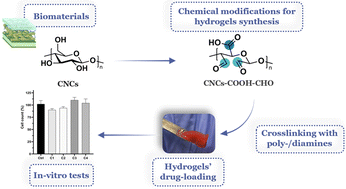
Nanocellulose-based hydrogels hold great promise for biomedical applications, particularly as localized drug delivery systems, due to their biocompatibility, tunable porosity, and soft-tissue mimicking properties. However, most reported systems rely on single-mode crosslinking strategies and exhibit rapid burst release, limiting sustained therapeutic delivery. Herein, we report the synthesis and full characterization of a novel bifunctional crystalline nanocellulose bearing both carboxy and dialdehyde groups. This dual-functionalization was achieved via a sequential (2,2,6,6-tetramethylpiperidin-1-yl)oxidanyl (TEMPO)-mediated oxidation followed by sodium periodate treatment, enabling reactivity with diamine-based crosslinkers. Hydrogels were prepared using either spermine or ε-poly-L-lysine through electrostatic or covalent crosslinking. The resulting materials exhibited tunable rheological properties, homogeneous and porous structures, and high in vitro biocompatibility. As a proof-of-concept, the chemotherapeutic agent doxorubicin was incorporated into selected hydrogel formulations, showing a sustained release over three weeks without a burst effect. These findings highlight the potential of bifunctional CNCs as a modular and customizable platform for the development of injectable hydrogels for prolonged local drug delivery.
- This article is part of the themed collection: Biomaterials Science Open Access Spotlight
 Please wait while we load your content...


