


 PLATFORM UPDATE:


Bioprinting of Exosomes
 cd
and
Emel
Sokullu
*de
cd
and
Emel
Sokullu
*de
Abstract
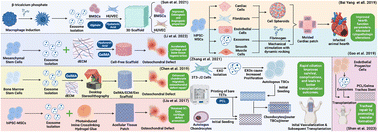
Exosomes (EXOs) help cells communicate by transporting proteins, lipids, and RNA. EXOs are being studied for diagnosis and treatment in oncology, regenerative medicine, and infectious diseases. EXOs’ research is limited because isolating high-purity EXOs in sufficient quantities impairs their therapeutic value. Bioprinting, which uses 3D printing to produce complex living objects, opens new avenues for medical research. 3D bioprinting can overcome limitations in EXO research. Bioprinting-customized microenvironments can imitate the natural biological setting, increasing the production of EXOs and their research. Bioprinting has enabled the development of precise, reproducible 3D models to study EXOs’ dynamics in a controlled setting. In three dimensions, bioprinted tissues can be used to study how EXOs affect cell-to-cell communication and disease progression. Additionally, bioprinted tissue models are essential for EXO-based therapeutic safety and efficacy testing. EXO bioprinting advances EXO isolation and application, clarifying their functions and therapeutic potential. Scientists enhance the scalability and precision of EXO production via bioprinting. By improving individualized EXO therapies, sophisticated printed models could revolutionize personalized medicine. Bioprinting technology is projected to revolutionize EXO modification and application, revolutionizing disease treatment and regenerative medicine. Overall, an emerging area of inquiry with great potential for cutting-edge biomedical research is presented, offering hope for more efficient therapeutic approaches leveraging Exos’ biological processes.
- This article is part of the themed collection: Biomaterials Science Open Access Spotlight
 Please wait while we load your content...


