


 PLATFORM UPDATE:


Bioactive cationic lipidated oligomers (CLOs) as antimicrobial materials: metabolomic insights into MRSA membrane disruption
 a
Jessica R.
Tait,
a
John F.
Quinn,
ac
Tony
Velkov,
b
Darren J.
Creek,
*a
Michael R.
Whittaker
*a
and
a
Jessica R.
Tait,
a
John F.
Quinn,
ac
Tony
Velkov,
b
Darren J.
Creek,
*a
Michael R.
Whittaker
*a
and
Abstract
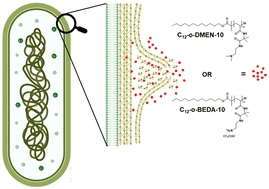
The escalating incidence of antimicrobial resistance in Staphylococcus aureus, particularly the methicillin-resistant strain (MRSA), necessitates the development of novel therapeutic strategies. Cationic lipidated oligomers (CLOs) have emerged as promising membrane-active antimicrobial agents; however, their mechanisms of action remain insufficiently understood. In this study, untargeted metabolomics was employed to systematically profile the temporal metabolic perturbations induced by two structurally distinct CLOs, C12-o-DMEN-10 and C12-o-BEDA-10, in MRSA across four defined time points (0.25, 0.5, 1, and 3 hours). These CLOs previously demonstrated differential antibacterial activity, as evidenced by dose-dependent propidium iodide (PI) uptake and growth inhibition assays. Metabolomic analysis revealed pronounced and sustained disruptions in bacterial membrane lipid metabolism, including significant depletion of phosphatidylglycerols (≥−2.5 log2FC, p < 0.05), alongside elevated levels of phosphatidylethanolamines, lysophospholipids, and fatty acid-derived metabolites indicative of membrane destabilization and lipid remodelling. Although both CLOs affected overlapping metabolic pathways, they differed in the extent and temporal dynamics of their effects. These findings provide mechanistic insights into CLO-mediated antibacterial activity and highlight the value of metabolomics in elucidating both direct and downstream cellular responses, which extend beyond the scope of conventional membrane integrity assays, such as PI fluorescence.
 Please wait while we load your content...


