


 PLATFORM UPDATE:


Biofabrication of 3D-printed fibrous scaffolds for large muscle tissue engineering: enhancing scalability, myotube formation and surgical handling
 a
Sebastian
Scholpp,
a
Anna
Fritschen,
a
Jamina Sofie
Gerhardus,
a
Regine
von Klitzing
c
and
a
Sebastian
Scholpp,
a
Anna
Fritschen,
a
Jamina Sofie
Gerhardus,
a
Regine
von Klitzing
c
and
Abstract
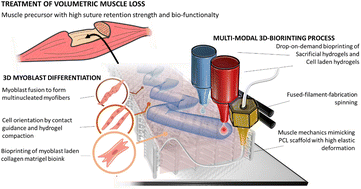
Volumetric muscle loss has a severe impact on patients’ quality of life, and current treatments often result in poor functional and aesthetic outcomes. This work aims to improve upcoming alternative treatments with tissue-engineered products, which currently are limited in size due to their production process. The methods used for achieving a cell-instructive growth milieu are designed for small volumes, lacking in nutrient supply structures and overall highly manual. To address these issues, we utilize a streamlined printing approach involving fused filament fabrication (FFF)-based spinning to produce fibrous muscle tissue engineering scaffolds. Similar to melt electro writing thin strands are drawn (around 100 µm), while retaining the advantages of FFF printing like fast and reliable production as well as a higher geometric freedom regarding patterns, shape, porosity and height tunable in the relevant range for volumetric muscle loss (width 0.5–15 cm, height 0.1–15 mm). These scaffolds are then combined with two bioinks which are infiltrated deeply into the scaffold with drop-on-demand printing. The first bioink consists of C2C12 myoblasts embedded in a collagen–matrigel matrix, while a second, sacrificial bioink is used to create vascular structures. Numerical simulations allowed for the scaffold design to be tailored, resulting in an anisotropic scaffold capable of repeated elastic deformation and spatio-temporal control of cell orientation, with up to 79.6% of aligned cells. This facilitates local isostatic conditioning, which is expressed in enhanced myotube formation. The tissue precursors simultaneously exhibit high biomechanical congruence (0.9–4.7 MPa), a high suture retention force (3.2 N per stitch) and shape retention (up to 80%), further augmented by the streamlined manufacturing process. These properties are pivotal for its prospective clinical translation.
- This article is part of the themed collection: Biomaterials Science Open Access Spotlight
 Please wait while we load your content...


