


 PLATFORM UPDATE:

A versatile bacterial cell wall-based nanomedicine for combination treatment of oral squamous cell carcinoma
 ac
and
Xiaoying
Yang
*a
ac
and
Xiaoying
Yang
*a
Abstract
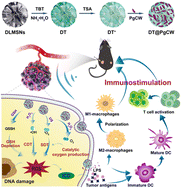
Oral squamous cell carcinoma (OSCC), an aggressive malignancy characterized by high recurrence and metastasis rates, continues to pose a significant clinical challenge to human health. Bacterial immunotherapy has emerged as a promising strategy for cancer treatment by activating multimodal immune responses. Porphyromonas gingivalis (Pg), an oral pathogenic bacterium strongly associated with periodontitis, can produce abundant μ-oxo bisheme on its cell wall (CW) to avoid the oxidative damage induced by H2O2 during inflammatory processes. Owing to the presence of μ-oxo bisheme, the CW extracted from Pg (PgCW) exhibits peroxidase (POD)-mimicking activity, as well as sonodynamic therapy (SDT) and chemodynamic therapy (CDT) performances, in addition to its intrinsic immunoadjuvant properties. Herein, PgCW is used as a versatile bacterial therapeutic agent to be loaded within mesoporous TiO2 grown in situ on dendritic large-pore mesoporous silica nanospheres, thus obtaining a nanomedicine termed DT@PgCW for OSCC combination treatment. Under ultrasound irradiation, DT@PgCW can promote the generation of substantial reactive oxygen species to induce the immunogenic cell death of OSCC cells by multimodal effects, including SDT, CDT, catalyzing the decomposition of H2O2 into O2, and depleting intracellular glutathione. Tumor antigens thus released can further elicit robust immune responses facilitated by the immunoadjuvant action of PgCW, subsequently suppressing OSCC recurrence and metastasis. Altogether, this study develops a versatile bacterial CW-based nanomedicine and provides an effective strategy for OSCC combination treatment.
 Please wait while we load your content...


