


 PLATFORM UPDATE:


Advances in lignin and lignin-based composites in biomedical applications

Abstract
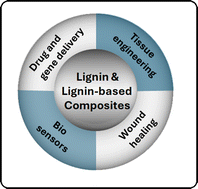
The development of biocompatible, biodegradable and mechanically robust materials for biomedical applications remains a major challenge. In this context, lignin has attracted increasing attention due to its abundant functional groups (hydroxyl and carboxyl), which enable it to act as an antioxidant, antibacterial, and anti-inflammatory agent. Furthermore, lignin is a naturally occurring biopolymer abundantly available from plants and biomass sources. These unique properties make lignin a potential candidate for various biomedical applications, including pharmaceutical and drug and gene delivery, wound healing, tissue engineering and scaffolds, and biosensors. Although several studies have explored the use of lignin in biomedical applications, there is still a lack of comprehensive reviews summarizing its applications across these domains. This review discusses the potential uses of lignin in biomedical applications, with a particular focus on recent advances. This review also provides a detailed overview of the various types and structures of lignin and their extraction processes, physicochemical properties, and biological activities. Moreover, it highlights the current state of the art in lignin-based technologies and outlines future perspectives for the development of lignin-based composites for biomedical applications.
 Please wait while we load your content...


