


 PLATFORM UPDATE:

Beyond polydopamine: expanding the horizon of polycatecholamines for biomaterials and biomedical technologies

Abstract
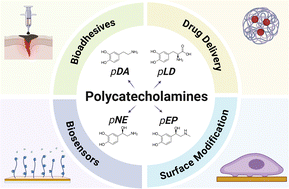
Polydopamine (pDA) has emerged as a benchmark material in bioinspired engineering, owing to its facile synthesis, strong adhesion, and chemical versatility. However, pDA is just one member of the broader polycatecholamine family, which includes poly-L-DOPA (pLD), polynorepinephrine (pNE), and polyepinephrine (pEP); each offering unique chemical functionalities and biological advantages. In this perspective, we critically assess the biomedical potential of these underexplored polymers, highlighting how their distinct physicochemical properties can expand current applications in surface modifications, coatings, biointerfaces, bioadhesives, biosensors, and carriers for drug delivery. Comparative analysis reveals that while pDA dominates the field, alternative polycatecholamines also exhibit equally attractive properties, such as enhanced hydrophilicity, biofunctionalization capacity, redox behaviour, and stimuli responsiveness. By broadening the focus beyond pDA, this work aims at catalysing future research on structurally diverse polycatecholamines as next-generation multifunctional biomaterials.
- This article is part of the themed collection: Biomaterials Science Open Access Spotlight
 Please wait while we load your content...


