


 PLATFORM UPDATE:

Bioresorbable-bioactive auxetic “personalised” phalanx with a CT-guided AI-driven model towards in vivo prediction of bone regeneration
 e
Santanu
Dhara
*a
e
Santanu
Dhara
*a
Abstract
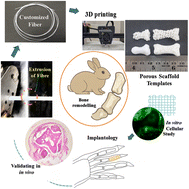
Trauma and diseases such as gangrene, diabetes mellitus, leprosy, or advanced-stage cancer requiring resections may lead to digit loss due to the limited capacity of tissue regeneration. The increasing global incidence of phalanx fractures necessitates surgical intervention for restoring organ function. Early mobilization post-surgery significantly improves the range of motion and overall functional outcomes, emphasizing the need for mechanically stable and biologically responsive solutions. In this study, a CT-derived, site-specific “personalized” phalanx reconstruction was fabricated using bioresorbable fibres by melt-extrusion printing. Scaffold architecture was optimized to provide partial mechanical stability, thus promoting early-stage soft-tissue integration and joint articulation. The composition of PCL–bioglass material was optimized as a bioactive template with biodegradability in vivo. Finite-element analysis (FEA) was employed to ensure efficient stress distribution, optimum deformation, and site-specific modulus matching. Physicochemical characterization, in vitro and in vivo biological assessment, especially site-specific implantation in a rabbit model, revealed the ability of the scaffold to accelerate bone remodelling. An AI-assisted mathematical model trained on micro-CT-derived experimental data was developed to predict the intermediate period of bone regeneration over three years, providing a next-generation solution for personalized implant-based treatment to restore skeletal tissue function.
 Please wait while we load your content...


