


 PLATFORM UPDATE:


Engineering microglial exosome-mediated microRNA-124-3p delivery for Alzheimer's disease combinational therapy

Abstract
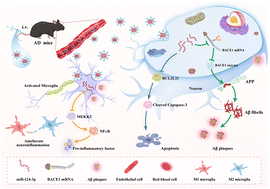
Currently, single-target therapy and difficulty in brain drug delivery gravely impede the treatment of Alzheimer's disease (AD). The promising development of microRNA-124-3p (miR-124-3p) serves as a possibility for multiple therapeutic approaches for AD. However, the effective delivery of miR-124-3p to AD-affected brain regions remains a major challenge, primarily due to the blood-brain barrier (BBB) and the inherent instability of therapeutic miR-124-3p. Herein, we engineered miR-124-3p-enriched microglial exosomes (Exo-124-3p) as a biomimetic nanomedicine for the multifunctional treatment of AD. Exo-124-3p can traverse the BBB and facilitate activated-microglia targeting. Subsequently, the on-demand release of miR-124-3p from Exo-124-3p decreased the aggregation of β-amyloid (Aβ) plaques, attenuated the activation of microglia/astrocytes, and exhibited a valuable neuroprotective effect, thereby remolding the AD focal microenvironment. Notably, the in vivo results demonstrated that Exo-124-3p significantly improved the cognitive function in an AD mouse model. Mechanistically, it was elucidated that Exo-124-3p can bind to the 3′UTR region of MEKK3, ultimately inhibiting the MEKK3/NF-κB signaling pathway, thereby ameliorating AD neuroinflammation. Consequently, this study not only provides a promising therapeutic approach for AD combinational therapy, but also advances the development of miRNA delivery in other brain diseases.
 Please wait while we load your content...


