


 PLATFORM UPDATE:

Controlling the protonic conductivity of full colour emitting carbon dot-doped biopolymers: role of functional groups

Abstract
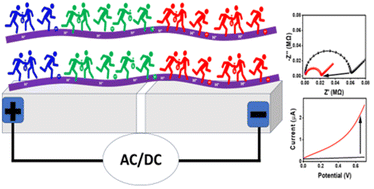
Proton-conducting biopolymers have gained significant attention in various fields, such as energy-related applications, ion exchange membranes, bioelectronics, and biomedical applications. To understand their proton transport mechanisms, it is crucial to distinguish the contributions of water, particularly near the surface functional groups of the dopants (carbon dots, C-Dots) and in the vicinity of the side chain functional groups of proteins in the biopolymer. In this study, we investigate the role of surface functional groups (dopants/biopolymers) in mediating proton conduction across biopolymers (protein-based) by the doping of blue-, green-, and red-emitting C-Dots (with different extents of oxygen-containing groups) into the biopolymer. We measure the proton conduction across the doped biopolymers with varying percentages of water and different extents of oxo-group-enriched dopants with the same internal structure to understand the role of surface functional groups in individual matrices and enhance the conductivity in a controlled way. This approach may provide insights into the proton conduction pathways in biological systems and aid in the development of bioprotonic devices.
 Please wait while we load your content...


