


 PLATFORM UPDATE:


A simple method for quantifying microplastics in water utilizing hydrophobic dyes via ultraviolet-visible spectrophotometry

Abstract
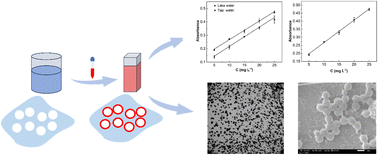
Polystyrene microplastics have emerged as a global environmental concern due to their widespread distribution and potential risks to ecosystems and human health. Accurate quantification of microplastics in water matrices remains challenging due to the limitations of conventional detection methods. This study adapted an incremental modification staining-spectrophotometry method for the quantitative detection of microplastic concentration in water, based on the adsorption of hydrophobic dyes onto the surface of microplastics, combined with UV-vis spectrophotometry. Under optimal conditions (pH = 7, room temperature, 1 µm polystyrene microplastics, deionized water, no interferents), there was a good linear relationship between absorbance and polystyrene microplastic concentration in the range of 5–100 mg L−1, with a correlation coefficient (R2) of 0.9933, a limit of detection of 0.76 mg L−1, and a spike recovery rate of 108.65%. Furthermore, the method exhibited strong anti-interference capability, retaining good linearity (R2 > 0.99) and recovery rates (>95%) under various environmental conditions, including temperatures of 25 °C and 45 °C, pH values of 3, 7, 11, and 13, and the presence of common coexisting ions (Ca2+, Na+, K+, SO42−, CO32−, and Cl−). Satisfactory linearity was also achieved in real water matrices such as tap water and lake water. Characterization using optical microscopy, scanning electron microscopy, and Fourier-transform infrared spectroscopy confirmed that the staining process involves physical adsorption without altering the chemical structure or morphology of the polystyrene microplastics. Compared with conventional methods, this approach offers advantages including operational simplicity, high sensitivity, good linearity, and strong environmental adaptability, making it a promising tool for rapid quantitative detection of small-sized polystyrene microplastics in water.
 Please wait while we load your content...


