


 PLATFORM UPDATE:


Domain-adaptive Raman spectral calibration transfer for cross-instrument glioma detection
 *a
*a
Abstract
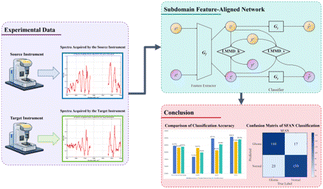
Glioma, a highly invasive tumor of the central nervous system with poor prognosis, requires accurate detection for effective clinical management, where rapid and precise tissue discrimination plays a critical role. Raman spectroscopy shows strong potential for real-time detection; however, spectral variations across different systems make it difficult to directly apply models trained on a master instrument (source domain) to a slave instrument (target domain). Therefore, model transfer becomes a key challenge. Existing methods typically rely on transfer set samples, requiring paired measurements of the same samples on both instruments to establish a mapping relationship, which is often impractical in real-world scenarios. Moreover, the limited number of target domain samples makes direct modeling prone to overfitting. To address these challenges, this paper proposes a Subdomain Feature Alignment Network (SFAN). Instead of performing spectral mapping, the proposed method conducts class-conditional alignment in the feature space by minimizing the Local Maximum Mean Discrepancy (LMMD), thereby learning domain-invariant and discriminative feature representations. To improve transfer stability under small sample conditions, a collaborative soft–hard label weighting mechanism is designed. Hard labels are used to guide the alignment direction, while soft labels are introduced to capture the probabilistic structure within classes, reducing the risk of incorrect alignment and alleviating overfitting. In addition, a two-stage network migration strategy is proposed to decouple cross-domain shared feature learning from target domain adaptation. This allows the model to first learn stable and generalizable features, followed by fine-tuning on the target domain, thereby enhancing transfer performance and robustness. Experimental results demonstrate that the proposed method outperforms conventional approaches on a human glioma dataset. By shifting from spectral mapping to feature alignment, the proposed method fundamentally improves model transferability and can be applied across different instruments and under varying measurement conditions. It provides a more general and effective framework for cross-domain modeling of Raman spectroscopy analysis under small sample scenarios.
 Please wait while we load your content...


