


 PLATFORM UPDATE:


Ratiometric fluorescent detection of phosgene in liquid and gas phases using a tautomeric dye: a combined experimental and theoretical study

Abstract
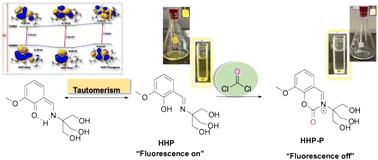
A new fluorescent probe, designated as ((E)-2-((2-hydroxy-3-methoxybenzylidene)amino)-2-(hydroxymethyl)propane-1,3-diol (HHP), was synthesized for selective detection of phosgene via a fluorescence-based cyclization mechanism. Initially, HHP exhibited high fluorescence with a strong emission signal at 502 nm, but the emission intensity was significantly reduced upon gradual addition of phosgene, with a ratiometric broad emission band at 450 nm and an isoemission point at 475 nm. Simultaneously, two strong absorption signals of HHP at 220 nm and 261 nm were diminished with an increase in a new red-shifted absorption signal at 290 nm, along with two isosbestic points observed at 272 nm and 312 nm. Within a very fast reaction time (30 s), the probe HHP detected phosgene with a limit of detection of 3.82 µM. The proton transfer pathway and the sensing mechanism of HHP with phosgene were demonstrated by a theoretical study, which were also investigated using a variety of spectroscopic techniques, such as mass spectrometry, UV-vis spectroscopy and emission spectroscopy. For practical applications, the sensor HHP can be used in a dipstick method for the detection of phosgene in the gaseous form by naked-eye colorimetric analysis.
 Please wait while we load your content...


