


 PLATFORM UPDATE:


Phosphate-mediated fluorescence switching in a UiO-66-NH2/red carbon dot hybrid for ratiometric and smartphone-assisted visual detection of ethephon
 a
Huifeng
Xu
*b
a
Huifeng
Xu
*b
Abstract
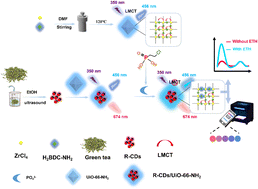
A smartphone-integrated ratiometric fluorescent platform was developed for on-site quantitative and visual detection of ethephon (ETH) using a UiO-66-NH2/red carbon dots (R-CD) hybrid probe. The R-CDs were synthesized from green tea via an environmentally friendly route. Upon hydrolysis, ETH releases phosphate ions that competitively coordinate with the Zr clusters of UiO-66-NH2, thereby inhibiting ligand–metal charge transfer (LMCT) and enhancing the blue fluorescence at 456 nm. Meanwhile, the red emission of R-CDs at 674 nm remains constant as an internal reference. The intensity ratio (F456/F674) exhibited a linear response to ETH concentrations ranging from 12.5 to 500 µM (R2 = 0.997), with a limit of detection (LOD) of 3.5 µM. The probe displayed a distinct red-to-blue fluorescence transition for visual semi-quantification. Quantitative analysis using smartphone RGB imaging exhibited a linear range of 50–500 µM and a LOD of 15 µM. The probe exhibited excellent selectivity against interfering ions and pesticides. It also demonstrated good reproducibility, as evidenced by intra- and inter-day RSDs of 5.11% and 3.94%, respectively. When applied to Coltsfoot flower samples, the method achieved spiked recoveries ranging from 92.71% to 112.14% by fluorometry and from 89.1% to 110.6% by visual detection, both of which agreed well with HPLC-MS/MS results. This platform demonstrated great potential for food safety monitoring.
 Please wait while we load your content...


