


 PLATFORM UPDATE:


Nanomaterial-enhanced molecular recognition: a Co3O4/TiO2 heterojunction electrochemical sensor for vanillin with experimental and DFT insights

Abstract
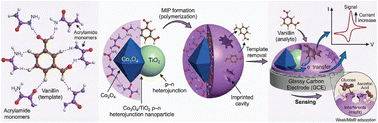
An advanced molecularly imprinted electrochemical sensor based on a Co3O4/TiO2 p–n heterojunction nanocomposite was developed for the selective determination of vanillin in complex food matrices. In this novel sensing platform, the heterostructured oxide core provides efficient interfacial charge transfer for enhanced sensitivity, while a surface-confined acrylamide-based molecularly imprinted polymer (MIP) introduces superior molecular recognition and antifouling capabilities. Structural and surface analyses confirmed successful heterojunction formation and polymer integration without electrical insulation of the active sites. Electrochemical characterization revealed a pronounced synergistic effect between the nanocomposite and the MIP, resulting in a substantial reduction in charge-transfer resistance and preservation of the electroactive surface area. Consequently, the sensor exhibited a wide linear range from 2.5 to 250 µM and a low detection limit of 0.06 µM using cyclic voltammetry. Density functional theory (DFT) and Monte Carlo adsorption simulations demonstrated that vanillin forms a highly stable hydrogen-bonding network with acrylamide at an optimal 1 : 3 ratio. Crucially, the calculated binding energies significantly exceeded those of common interferents such as glucose and ascorbic acid, providing a robust mechanistic basis for the sensor's high selectivity. The sensor was successfully applied to milk, ice cream, biscuits, coffee, and iced tea, delivering recoveries of 96.8–103.2% and excellent agreement with HPLC and UV-vis methods. The platform retained over 89% of its initial response after 42 days under refrigerated storage. This work establishes a rationally designed, DFT-supported MIP/nanocomposite heterojunction strategy for robust electrochemical sensing in chemically aggressive matrices, highlighting the immense potential of hybrid nanomaterials in analytical applications.
- This article is part of the themed collection: Nanomaterials for Sensing
 Please wait while we load your content...


