


 PLATFORM UPDATE:


Deep learning-empowered SERS: deciphering the multidimensional information code of complex biological samples
 a
and
a
and
Abstract
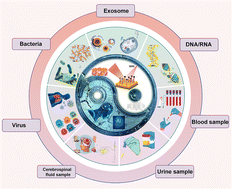
Surface-enhanced Raman spectroscopy (SERS), an analytical technique characterized by fingerprint-like identification capabilities and high sensitivity, has demonstrated significant application value across diverse fields such as biomedicine, environmental protection, and food safety. However, spectral noise inherent in the detection process introduces potential interference, thereby reducing the signal-to-noise ratio (SNR) and compromising the accuracy and reliability of sample analysis. This limitation has spurred the development of Raman spectral denoising algorithms to encourage the application of Raman spectroscopy in more complex domains of analytical chemistry. Deep learning (DL) has demonstrated remarkable autonomy in learning high-level representations and recognizing complex patterns. Consequently, facing intertwined influencing factors and exponentially growing data volumes, AI is finding increasing application in the aforementioned aspects of SERS. In this review, by integrating deep learning with surface-enhanced Raman scattering technology, we summarize its recent advancements and provide novel insights into the challenges and future prospects, aiming to propel SERS technology towards more advanced development.
- This article is part of the themed collection: Analytical Methods Review Articles 2026
 Please wait while we load your content...


