


 PLATFORM UPDATE:

β-Cyclodextrin based host–guest complexation of 3-(2-pyridyl) acrylic acid for stability enhancement and aqueous-phase ascorbic acid detection

Abstract
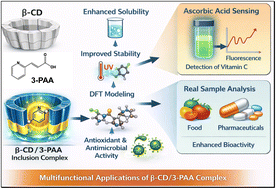
The development of efficient host–guest inclusion systems to enhance the solubility, stability, and sensing performance of bioactive molecules remains a significant research challenge. In this study, an inclusion complex of 3-(2-pyridyl) acrylic acid (3-PAA) with β-cyclodextrin (β-CD) was successfully prepared and systematically investigated. The formation of a 1 : 1 host–guest complex was confirmed by UV-visible spectroscopy, fluorescence analysis, Job's plot, phase-solubility studies, FT-IR, 1H NMR, SEM, DSC, TGA and DFT study. Phase-solubility results revealed an AL-type profile with a significant enhancement in aqueous solubility and a stability constant in the order of 103 M−1, indicating strong host–guest interaction, supported by a negative ΔG value. The inclusion complex exhibited improved photostability and thermal stability compared to free 3-PAA. Notably, the β-CD inclusion complex demonstrated selective, sensitive fluorescence detection of ascorbic acid in water, exhibiting a low detection limit (0.18 µM) and wide linear range. Practical applicability was validated via real sample analysis of vitamin C tablets and fruit juices, showing satisfactory recovery and accuracy. Furthermore, enhanced antioxidant and antibacterial activities were observed upon complexation. Overall, the 3-PAA–β-CD inclusion complex offers a multifunctional supramolecular platform with improved physicochemical properties and promising applications in chemical sensing and biomedical fields.
 Please wait while we load your content...


