


Self-powered PEC/EC dual-mode sensing platform for sensitive TNF-α detection based on multifunctional mesoporous silica nanospheres
 *a
and
Hong
Zhou
*a
*a
and
Hong
Zhou
*a
Abstract
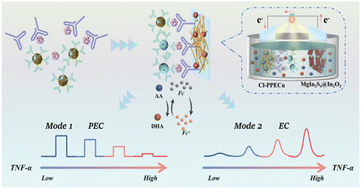
As a multifunctional cytokine, tumor necrosis factor-alpha (TNF-α) participates in the development of inflammation-associated carcinogenesis. Since TNF-α is overexpressed in patients with early-stage tumors, a sensitive detection method is essential for disease diagnosis. In this work, a self-powered platform for the photoelectrochemical-electrochemical (PEC-EC) detection of TNF-α has been constructed. This platform was composed of a MgIn2S4@In2O3 photoanode and Cl/PPECu photocathode. MnO2-coated mesoporous silica@ferrocene (MFMSN) was used as the bifunctional material for PEC-EC dual-mode detection. In the presence of TNF-α, MFMSN served as the photocathode quenching source to change the photocurrent through steric hindrance and consumption of ascorbic acid (AA). In the meantime, ferrocene (Fc) was released from MFMSN during the dissociation of MnO2 and catalyzed the oxidation of AA for current response amplification. This principle enabled the achievement of high-sensitivity dual-mode determination for TNF-α. As a result, the self-powered platform achieved detection limits of 0.140 fg mL−1 and 2.65 fg mL−1 in PEC and EC modes, respectively, with a detection range of 5.00 fg mL−1–5.00 ng mL−1 (PEC) and 10.0 fg mL−1–10.0 ng mL−1 (EC). In addition, this biosensor was also applied to quantify TNF-α in human serum with acceptable results. This dual-mode analysis strategy provided a highly reliable and accurate detection of TNF-α.
- This article is part of the themed collection: Analytical Methods HOT Articles 2026
 Please wait while we load your content...


