


 PLATFORM UPDATE:


Rapid ultrasensitive detection of levamisole and mebendazole residues in meat products based on an intelligent nanozyme-imprinted fluorescence microfluidic sensor
 *abc
*abc
Abstract
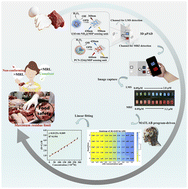
Veterinary drug residues in food pose a significant threat to human health, and developing advanced detection tools is important for food safety. In this study, a nanozyme ratiometric fluorescence paper-based microfluidic imprinted sensor assisted with an intelligent analysis module was developed, enabling on-site, rapid and ultrasensitive detection of levamisole (LMS) and mebendazole (MBZ) residues in meat products. Molecularly imprinted sensing units based on metal–organic framework fluorescent materials (UiO-66-NH2@MIP and PCN-224@MIP) with peroxidase-like activity were fabricated to establish a dual-channel ratiometric fluorescence detection system based on the H2O2/o-phenylenediamine reaction. Under excitation at 360 nm for LMS and 420 nm for MBZ, by integrating fluorescence image acquisition using a smartphone with MATLAB program-driven image processing technology, the UiO-66-NH2@MIP/PCN-224@MIP paper-based microfluidic sensor achieved rapid quantitative detection within 12 minutes, exhibiting a linear response range of 0.05–2.8 µM for LMS and 0.05–3.2 µM for MBZ. Satisfactory recoveries of 98.2–103.2% and excellent reproducibility (RSD = 1.68% for LMS and 3.17% for MBZ, n = 5) were obtained in spiked meat samples. This microfluidic sensor based on image-processing/smartphone readout achieves on-site, portable, rapid and ultrasensitive detection of LMS and MBZ residues in meat products without sophisticated equipment, providing a novel and practical approach for food quality and safety assurance.
 Please wait while we load your content...


