


 PLATFORM UPDATE:


A TiO2/Ti3C2 MXene photoelectrochemical chip with multiphysics field engineering for quantification of wastewater DNA

Abstract
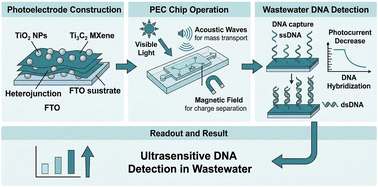
A photoelectrochemical chip integrating a TiO2/Ti3C2 MXene heterostructured photoelectrode and multiphysics field engineering was developed for ultrasensitive quantification of deoxyribonucleic acid in wastewater. The TiO2/Ti3C2 composite was synthesized via an in situ hydrothermal approach, forming an intimate Schottky heterojunction that significantly enhanced visible-light absorption and charge carrier separation. The optimized composite exhibited a narrowed bandgap of 2.92 eV, a high specific surface area of 135.4 m2 g−1, and a photocurrent density of 4.5 µA cm−2, representing a 22.5-fold enhancement compared with pristine TiO2. To further amplify sensing performance, the photoelectrode was integrated into a microfluidic platform employing simultaneous acoustic and magnetic fields, enabling accelerated mass transport and suppressed charge recombination. Under these multiphysics field conditions, the photocurrent response increased by 86% relative to the static configuration. The resulting biosensor demonstrated a wide linear detection range from 5.0 fM to 50 nM with an exceptionally low detection limit of 1.5 fM. High sequence selectivity was achieved, with single-base mismatched DNA producing less than 15% of the target signal, while non-complementary sequences generated negligible responses. The sensor showed good analytical reproducibility, with an RSD of 3.8% for independently fabricated sensors, a chip-to-chip RSD of 4.6% within one fabrication batch, and an inter-batch RSD of 5.2% across three independent batches. In addition, the device retained 94.5% of its initial response after 30 days of storage and 90.4% of its initial photocurrent after 100 repeated chopped-light illumination cycles, confirming acceptable fabrication consistency and operational PEC stability. Practical applicability was validated using spiked real wastewater samples, yielding recovery rates between 96.5% and 104.2% in good agreement with quantitative polymerase chain reaction analysis. This work demonstrates an effective strategy that combines advanced heterojunction engineering with multiphysics field modulation to enable rapid, sensitive, and reliable environmental nucleic acid monitoring.
 Please wait while we load your content...


