


 PLATFORM UPDATE:


Plasma NIR spectral pattern recognition applied for rapid screening of overt and occult HBV infections
 *a
*a
Abstract
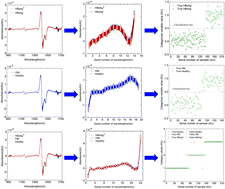
Hepatitis B virus (HBV) infection screening includes hepatitis B surface antigen (HBsAg) and HBV DNA detection. HBsAg detection can only screen for overt HBV infection; HBV DNA can screen for occult HBV infection (OBI), but the method is complex, expensive, and often excluded from routine examinations, risking missed OBI diagnoses. Using plasma near-infrared (NIR) spectral pattern recognition, two-classification discriminant models for HBsAg+–HBsAg− and OBI–healthy, and a three-classification discriminant model for HBsAg+–OBI–healthy were established. A total of 657 plasma samples (HBsAg+ 213, OBI 204, and healthy 230) were collected; the NIR spectra were measured and were divided into training, prediction, and external validation sets. Partial least squares-discriminant analysis (PLS-DA) and k-nearest neighbor (kNN) were used as classifiers; Norris derivative filtering (NDF) was used for spectral preprocessing; the integrated algorithm of equidistant combination (EC) and wavelength step-by-step phase-out (WSP) was used for wavelength optimization. For above two binary classifications, the numbers of wavelengths (N) of the optimal EC-WSP-PLS-DA model with NDF were 26 and 36, respectively; in the independent external validation, the sensitivity and specificity reached 100%. For the above three-classification discriminant, the N of the optimal EC-WSP-kNN model with NDF was 24; in the independent external validation, the total recognition-accuracy rate reached 98.1%. The results showed that plasma near-infrared spectral pattern recognition can accurately perform two-classification and three-classification discrimination of HBsAg+, OBI, and healthy individuals. This method is reagent-free, rapid, and simple, which can simultaneously detect overt and occult HBV infections. The proposed few-wavelength model can be used for the development of small-scale dedicated spectrometers.
 Please wait while we load your content...


