


 PLATFORM UPDATE:


A dual-quenched photoelectrochemical immunosensor based on a CdS/SrTiO3 heterojunction for CA12-5 sensitive detection

Abstract
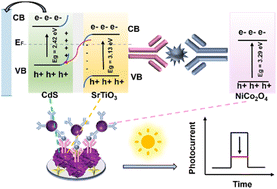
The early diagnosis and postoperative monitoring of ovarian cancer rely significantly on the sensitive detection of antigen CA12-5. In this work, a photoelectrochemical immunosensor was developed for the detection of CA12-5, utilizing a CdS/SrTiO3 heterojunction as the photoactive matrix and NiCo2O4 as a quencher probe. The Z-type heterojunction promotes the separation of photogenerated electrons and holes, suppresses the recombination of charge carriers, and thereby significantly enhances the initial photocurrent response. Furthermore, the introduced NiCo2O4 quencher generates steric hindrance and competes effectively with the photosensitive material for light absorption, leading to a reduction in the photocurrent signal. This quenching effect greatly enhances the detection sensitivity for CA12-5. The fabricated immunosensor exhibited excellent selectivity and stability under optimal conditions, achieving a wide linear detection range from 5 pg mL−1 to 50 ng mL−1 and a low detection limit of 1.3 pg mL−1.
- This article is part of the themed collection: Analytical Methods HOT Articles 2026
 Please wait while we load your content...


