


 PLATFORM UPDATE:


A potential-resolved electrochemiluminescent aptasensor for simultaneously detecting MUC1 and HER2 on breast cancer exosomes
 *a
Qingjiang
Wang
*b
*a
Qingjiang
Wang
*b
Abstract
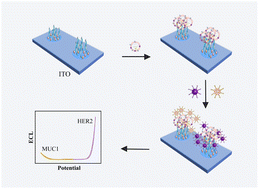
Breast cancer is one of the most serious threats to women's health. The simultaneous detection of tumor markers is crucial for improving the survival rate of patients. Herein, a potential-resolved electrochemiluminescent (ECL) aptasensor has been developed for the simultaneous detection of MUC1 and HER2 proteins on the surface of breast cancer cell-derived exosomes. Exosomes were specifically captured via CD63 aptamers immobilized on an indium tin oxide (ITO) electrode. Ru(bpy)32+@SiO2 nanoparticles (Ru@SiO2) and luminol@Au nanoparticles (lum@Au) labeled with the corresponding aptamers of the MUC1 and HER2 proteins, respectively, were employed as ECL nanoprobes to specifically recognize these two proteins expressed on exosomes, and were anchored on two independent regions of an ITO electrode patterned by polydimethylsiloxane (PDMS). This physical isolation eliminated ECL resonance energy transfer (ECL-RET) between the nanoprobes. The ECL behaviors of the two nanoprobes at different potentials were recorded under cyclic voltammetry scanning, achieving the simultaneous detection of both proteins. Under the optimized conditions, the ECL aptasensor exhibited favorable linear response relationships for MUC1 and HER2 on four types of exosomes, thus enabling the quantitative analysis and the reliable discrimination of these distinct exosomal subtypes. Endowed with excellent specificity, stability and reproducibility, this aptasensor was further applied to the detection of serum samples, demonstrating potential for clinical application.
 Please wait while we load your content...


