


Bisbenzimidazoles with a benzenediyl spacer: an efficient fluorophore for dihydrogen phosphate sensing and targeted living cell imaging

Abstract
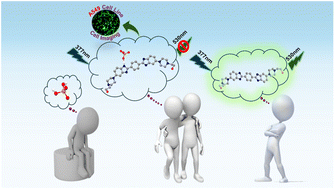
A bisbenzimidazole-based fluorescent probe (PBZ) has been developed for the selective detection of dihydrogen phosphate [H2PO4]− ions in a CH3CN–water (7 : 3, v/v) mixed solvent system. The probe exhibited pronounced spectral responses upon interaction with [H2PO4]−, including the emergence of a new charge-transfer absorption band and a distinct fluorescence turn-off behavior. PBZ displayed excellent selectivity toward [H2PO4]− over other competing anions and demonstrated a limit of detection (LOD) of 1.87 µM. Binding analysis, supported by density functional theory (DFT), confirmed the formation of a stable 1 : 1 hydrogen-bonded host–guest complex with [H2PO4]−. Furthermore, the probe showed rapid response, good solvent compatibility, low cytotoxicity, and effective intracellular fluorescence imaging in A549 cells, demonstrating its potential as a biocompatible chemosensor for phosphate monitoring in environmental and biomedical applications.
 Please wait while we load your content...


