Bisbenzimidazoles with a benzenediyl spacer: an efficient fluorophore for dihydrogen phosphate sensing and targeted living cell imaging

Abstract

A bisbenzimidazole-based fluorescent probe (PBZ) has been developed for the selective detection of dihydrogen phosphate [H2PO4] ions in a CH3CN–water (7 : 3, v/v) mixed solvent system. The probe exhibited pronounced spectral responses upon interaction with [H2PO4], including the emergence of a new charge-transfer absorption band and a distinct fluorescence turn-off behavior. PBZ displayed excellent selectivity toward [H2PO4] over other competing anions and demonstrated a limit of detection (LOD) of 1.87 µM. Binding analysis, supported by density functional theory (DFT), confirmed the formation of a stable 1 : 1 hydrogen-bonded host–guest complex with [H2PO4]. Furthermore, the probe showed rapid response, good solvent compatibility, low cytotoxicity, and effective intracellular fluorescence imaging in A549 cells, demonstrating its potential as a biocompatible chemosensor for phosphate monitoring in environmental and biomedical applications.
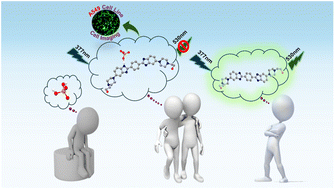
Graphical abstract: Bisbenzimidazoles with a benzenediyl spacer: an efficient fluorophore for dihydrogen phosphate sensing and targeted living cell imaging

Supplementary files

Transparent peer review

To support increased transparency, we offer authors the option to publish the peer review history alongside their article.

View this article’s peer review history

Article information

Article type
Paper
Submitted
06 Dec 2025
Accepted
24 Feb 2026
First published
24 Feb 2026

Anal. Methods, 2026, Advance Article

Bisbenzimidazoles with a benzenediyl spacer: an efficient fluorophore for dihydrogen phosphate sensing and targeted living cell imaging

R. Debnath, S. Saha, S. Kundu, A. De, S. Mondal, M. Kotakonda, N. Dey and B. Biswas, Anal. Methods, 2026, Advance Article , DOI: 10.1039/D5AY02020D

To request permission to reproduce material from this article, please go to the Copyright Clearance Center request page.

If you are an author contributing to an RSC publication, you do not need to request permission provided correct acknowledgement is given.

If you are the author of this article, you do not need to request permission to reproduce figures and diagrams provided correct acknowledgement is given. If you want to reproduce the whole article in a third-party publication (excluding your thesis/dissertation for which permission is not required) please go to the Copyright Clearance Center request page.

Read more about how to correctly acknowledge RSC content.

Social activity

Spotlight

Advertisements