


 PLATFORM UPDATE:


A hypoxia activated fluorescent probe for the specific visualization of mitochondrial dysfunction in tumors
 *a
Ruoyao
Zhang
*b
*a
Ruoyao
Zhang
*b
Abstract
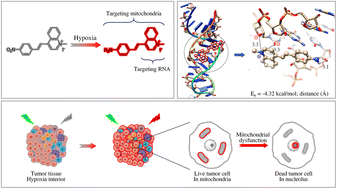
Selectively monitoring the mitochondrial dysfunction and viability of tumors is an important task for the treatment of cancer and is helpful for determining the appropriate radiotherapy and chemotherapy dose to minimize side effects. However, tumor-specific fluorescent probes that enable the visualization of mitochondrial dysfunction in tumor tissues have rarely been reported. Herein, a hypoxia-activated fluorescent probe (NTQ) was fabricated for selectively visualizing and monitoring mitochondrial dysfunction in tumors. NTQ was designed by linking a nitrobenzene unit to a quinolinium moiety to form an “A–π–A” electronic structure. Under hypoxic conditions, NTQ is reduced to ASQ with a “D–π–A” electronic structure to give enhanced deep-red fluorescence. ASQ was designed to have a positive charge and high affinity to RNA, thus targeting mitochondria in live cells and being able to detect reversible changes in the mitochondrial membrane potential by its relocation into the nucleolus. In this manner, NTQ enables the selective visualization of hypoxic tumors whilst simultaneously identifying mitochondrial dysfunction in tumors. The probe reveals that increasing the oxidative stress under hypoxia can efficiently lead to tumor cell apoptosis, and traditional anti-tumor drugs including paclitaxel and colchicine can lead to tumor cell apoptosis under hypoxic conditions. It is particularly noteworthy that tumor tissues were selectively illuminated by the NTQ probe and that the mitochondrial dysfunction in tumor tissues was successfully detected with NTQvia its migration from the mitochondria to the nucleolus.
 Please wait while we load your content...


