


 PLATFORM UPDATE:

Design and synthesis of a cobalt-doped carbon dot nanozyme for colorimetric/fluorometric dual-mode detection of nitrite ions and antibacterial applications
 a
Saipeng
Huang
*a
a
Saipeng
Huang
*a
Abstract
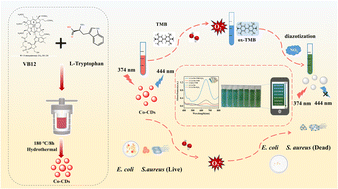
In this work, novel cobalt-doped carbon dots (Co-CDs) were constructed via a facile single-step hydrothermal synthesis approach utilizing vitamin B12 (VB12) and L-tryptophan (L-Try) as precursors. Co-CDs illustrated exceptional peroxidase-like (POD) reactivity. A dual-mode analytical platform integrating fluorescence and UV-vis colorimetry was established based on the catalytic properties of Co-CDs, which can specifically quantify NO2− across diverse environmental matrices with high accuracy and low detection limit (123.1 nM). Additionally, a smartphone-assisted colorimetric analytical method was established for on-site monitoring of NO2− with satisfactory recoveries (92.905–106.2%) in real water samples. More importantly, the antimicrobial applications of Co-CDs were explored, and strong antibacterial performances were observed against E. coli and S. aureus. This research not only presents a novel strategy for constructing a highly catalytic nanozyme for highly sensitive detection of NO2− but also provides a versatile platform bridging advanced nanomaterials with point-of-care detection technologies.
 Please wait while we load your content...


