


 PLATFORM UPDATE:


Recent progress in metal–organic gels for fluorescent sensing: design, mechanisms, and applications

Abstract
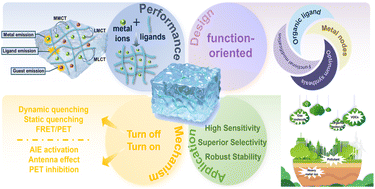
Metal–organic gels (MOGs) are a class of dynamic three-dimensional soft materials formed by the self-assembly of metal ions or clusters with organic ligands under mild conditions. Owing to their tunable porous structures, abundant active sites, exceptional optical properties, and enhanced environmental stability, MOGs have emerged as promising candidates for fluorescence sensing applications. This review presents a systematic overview of recent advancements in MOG-based fluorescence sensing, which is structured around the logical framework of “properties-design-mechanism-application”. It covers key aspects including the fundamental fluorescent properties of MOGs, rational design strategies for optimizing sensing performance, core fluorescence sensing mechanisms, and representative applications in the fields of environmental monitoring, food safety detection, and biomedical analysis. Finally, critical challenges and future perspectives in this rapidly evolving field are discussed, aiming to provide guidance for further research directions.
- This article is part of the themed collections: Analytical Methods Review Articles 2026 and Analytical Methods HOT Articles 2026
 Please wait while we load your content...


