


Provenance and firing technology of Qingbai porcelain unearthed from the Shuyuanjie site in Song Dynasty China: a multi-analytical investigation
 *ab
*ab
Abstract
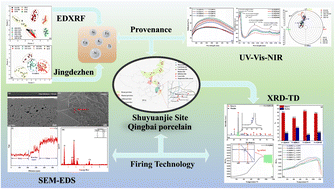
This study conducted a systematic analysis of the Qingbai porcelain from the Shuyuanjie site (Song Dynasty, China). The chemical composition of the bodies and glazes, along with glaze color, phase composition, firing temperature, and microstructure, was investigated using multiple techniques, including EDXRF, UV-Vis-NIR, XRD, thermal dilatometry (TD), and SEM-EDS, to elucidate the porcelain's provenance and firing techniques. The results indicate that the porcelain bodies exhibit high-silica and low-alumina characteristics, with quartz and mullite as the dominant phases, and firing temperatures ranging from 1070 °C to 1185 °C. The glaze layers (150–206 µm thick) consist primarily of a glassy matrix with minor crystallites and spherical phase-separated structures. The chemical compositional features of both body and glaze suggest a Jingdezhen (Jiangxi Province) origin, with the samples classified into two groups: (1) SYJ-I (5 samples, excluding SYJQB02), characterized by a calcium–alkali glaze with a dominant wavelength of 510–515 nm; and (2) SYJ-II (37 samples), featuring a calcium glaze with dominant wavelengths distributed between 510 and 575 nm. Both glaze types exhibit bluish-green hues, with compositional differences mainly attributed to alkali and alkaline earth metal oxide contents. These findings indicate that Qingbai porcelain was produced in Jingdezhen and its surrounding kiln complexes during a period of stable technological development in these production centers and subsequently traded to Henan Province.
 Please wait while we load your content...


