


 PLATFORM UPDATE:


Rapid quality assessment of organic fertilizers using fused FTIR and LIBS spectroscopy with machine learning
 *ab
*ab
Abstract
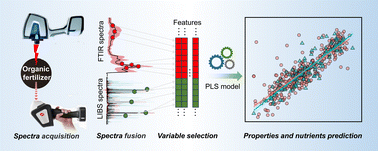
Organic fertilizers are vital for sustainable agriculture, but conventional quality assessment methods are often time-consuming and costly. This study developed a rapid analytical framework by synergistically combining Fourier transform infrared spectroscopy (FTIR) and laser-induced breakdown spectroscopy (LIBS). We integrated two-dimensional correlation spectroscopy (2DCOS), machine learning algorithms, spectral fusion, and variable selection to characterize organic fertilizer properties comprehensively. The 2DCOS analysis revealed significant organo–mineral interactions, showing enhanced coupling between organic carbon and minerals in composted fertilizers. For predictive modeling, partial least squares regression (PLSR) performed optimally for nitrogen (N) and potassium (K) using individual FTIR and LIBS spectra, respectively. Furthermore, spectral fusion significantly improved model performance: when combined with competitive adaptive reweighted sampling (CARS-PLSR), it achieved superior prediction accuracy for pH (R2 = 0.92) and organic carbon (R2 = 0.89). Similarly, random frog-PLSR (RFrog-PLSR) with fused spectra provided the best prediction for phosphorus (P) (R2 = 0.85). This optimized FTIR-LIBS approach establishes an efficient and eco-friendly analytical framework for comprehensive organic fertilizer assessment, offering substantial advantages in speed and cost-effectiveness over traditional methods.
 Please wait while we load your content...


