


 PLATFORM UPDATE:


Gold nanoparticle aptasensor synergizing colorimetric and Tyndall effect signals for ultrasensitive ATP detection
 *a
*a
Abstract
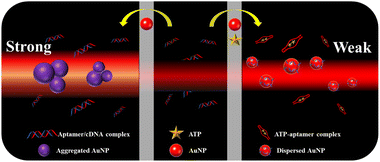
Conventional ATP detection methods (e.g., fluorescence and electrochemistry) face significant sensitivity constraints, while colorimetric approaches—despite offering visual simplicity—remain inadequate for clinical applications due to limited detection capabilities. To address this dual challenge, we developed a dual-mode nanosensor leveraging gold nanoparticles (AuNPs), which synergistically integrates colorimetric signals (aggregation-induced red-to-blue shift) and Tyndall effect scattering for ultra-sensitive ATP quantification. The core mechanism exploits aptamer-mediated recognition: ATP binding triggers the release of cDNA from dsDNA complexes, enabling cDNA adsorption onto AuNPs to inhibit salt-induced aggregation. The proposed sensor demonstrates three major improvements: 125-fold sensitivity enhancement versus conventional colorimetry, record-low detection limits of 0.17 µM (colorimetric) and 1.28 nM (Tyndall effect), and a broad linear detection range (0.25–750 µM, R2 > 0.91) with 5 min visual readout. Validation in complex yogurt matrices demonstrated exceptional robustness, yielding 96.1–110.2% recovery and precision (RSD < 10%). This cost-effective, minimal-equipment platform (requiring only a laser pointer for Tyndall readout) shows potential to bridge point-of-care screening with laboratory-grade quantification, highlighting its promising applicability for clinical diagnostics and environmental monitoring.
 Please wait while we load your content...


