


 PLATFORM UPDATE:


Development of a cellulose acetate-based polymeric membrane for the extraction and quantification of fluoxetine and norepinephrine in biological samples
 *a
and
*a
and
Abstract
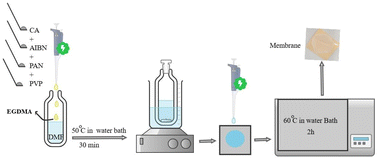
In this study, a cellulose acetate based polymer membrane was synthesized via wet phase inversion and applied as an adsorptive medium for the extraction and determination of fluoxetine (FL) and norepinephrine (NE) from human blood serum and urine. The membrane was fabricated by incorporating polyvinylpyrrolidone (PVP) as a pore-forming agent, ethylene glycol dimethacrylate (EGDMA) as a cross-linker monomer, azobisisobutyronitrile (AIBN) as an initiator, and polyacrylonitrile (PAN) as a structural support. Structural and morphological characterization was performed using Fourier Transform Infrared (FT-IR), X-ray diffraction (XRD), and Field Emission Scanning Electron Microscopy (FE-SEM), confirming the successful formation of an amorphous, porous membrane with suitable functional groups for adsorption. Extraction parameters were systematically optimized using a Central Composite Design (CCD). The method exhibited excellent linearity for NE (0.1–200 µg L−1, R2 = 0.9984) and FL (0.5–200 µg L−1, R2 = 0.9992). Limits of detection were 0.05–0.2 µg L−1, while limits of quantification ranged from 0.16 to 0.66 µg L−1. Precision was demonstrated with intra- and inter-day RSD values below 5.6%. Recoveries from spiked urine and serum samples exceeded 90.30% with RSD < 5.7%.
 Please wait while we load your content...


