


 PLATFORM UPDATE:


Fingerprinting combined with chemometrics: new strategies and advances in quality evaluation of traditional Chinese medicine
 b
and
Jing
Zhang
*a
b
and
Jing
Zhang
*a
Abstract
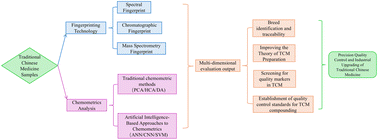
In the field of global health, the quality of Traditional Chinese Medicine (TCM) holds pivotal significance. Ensuring the clinical efficacy and medication safety of TCM not only enhances international trust in TCM, injecting strong impetus into the process of TCM globalization, but also promotes the dissemination of traditional medical culture, strengthens cultural exchanges between China and foreign countries, enriches the global medical system, and realizes complementary advantages with modern medicine. In recent years, the application of fingerprinting combined with chemometrics in TCM quality evaluation has attracted increasing attention from both academic and industrial circles. Among them, fingerprinting technology can intuitively display the overall characteristics and internal correlations of chemical components in TCM, while chemometrics, by means of multivariate statistical analysis, pattern recognition and other methods, performs dimensionality reduction on fingerprint data, constructs new models, and thus deeply excavates the potential effective information hidden in the data. The synergistic application of these two technologies in TCM quality evaluation shows significant advantages: in terms of TCM origin tracing, it can accurately analyze the differences in TCM components under different producing areas and growth environments, realizing precise traceability of medicinal materials; in the work of authenticity identification, it can effectively identify counterfeits by comparing characteristic fingerprints and data differences, ensuring the authenticity of medicinal materials; in the content determination link, combined with chemometric algorithms, it can realize simultaneous quantitative analysis of multiple components, improving detection efficiency and accuracy; for compound TCM, this technology combination can comprehensively consider the interactions among various components to conduct comprehensive quality evaluation. This article systematically reviews the research progress of the integration of this technology in the field of TCM quality evaluation in recent years, elaborates on the research overview in various key links and the specific methods of compound medicine quality evaluation, and looks forward to its future development trends and application prospects. It aims to provide strong support for constructing a standardized, standardized and comprehensive theoretical research system of TCM, and help realize the goals of precision, clarity, predictability and controllability of TCM quality.
- This article is part of the themed collection: Analytical Methods Review Articles 2026
 Please wait while we load your content...


