


 PLATFORM UPDATE:

Estimation of the metabolic stability of omipalisib in human liver microsomes employing an ultra-fast UPLC-MS/MS approach: in silico screening for structural alarms and metabolic lability

Abstract
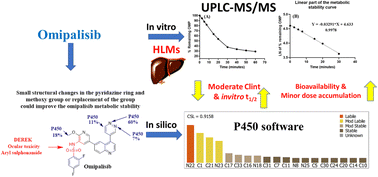
Omipalisib (OMP) is a powerful dual inhibitor of the mTOR and PI3K enzymes, demonstrating anti-tumor effectiveness in multiple cancer types. No reported UPLC-MS/MS method with in silico metabolism analysis and combined green metrics has been reported for OMP; hence, an ultra-fast, dependable, and eco-friendly UPLC-MS/MS approach was developed for quantifying OMP in human liver microsomes (HLMs) and assessing in vitro OMP metabolic stability. The UPLC-MS/MS method validation conformed to the US-FDA guidelines for bioanalytical approach validation. The StarDrop software package (DEREK and WhichP450 modules) was utilized to identify in silico alerts on the OMP chemical structure and its metabolic lability. The developed UPLC-MS/MS method showed linearity over a concentration range of 1–3000 ng mL−1, accomplished ultra-rapid analysis in 1 minute, and exhibited accuracy and repeatability devoid of HLM effects. OMP and duvelisib (internal standard) were evaluated using an SB-C18 column. The intra- and inter-day evaluations for the precision and accuracy of the UPLC-MS/MS method ranged from −1.05% to 6.67% and −2.04% to 7.67%, respectively. The in vitro half-life (t1/2) of OMP was 21.07 minutes, and its intrinsic clearance (Clint) was 38.48 mL min−1 kg−1. In silico analysis indicates that slight structural modifications to the methoxy group or the pyridazine ring in the process of drug design may increase the safety profile and metabolic stability of new derivatives compared with those of OMP. The integrated in vitro/in silico approach provides a resource-efficient strategy for preliminary metabolic screening and advancing new therapeutic developments aimed at enhancing metabolic stability.
 Please wait while we load your content...


