


 PLATFORM UPDATE:

Determination of paraquat in drinking water by HPLC-UV using large-volume injection and a superficially porous particle HILIC column
 a
and
Mariana R.
Gama
*a
a
and
Mariana R.
Gama
*a
Abstract
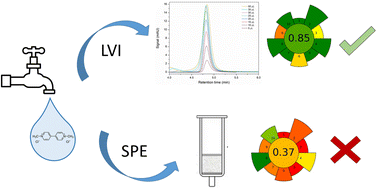
Paraquat is a highly polar herbicide that can be detected in environmental water samples due to its unauthorized use in agriculture and its high mobility in aquatic systems. Its determination at trace levels remains analytically challenging, particularly when using conventional multiresidue methods based on reversed-phase liquid chromatography, which often requires ion-pairing reagents that compromise the method precision. In this work, the application of a large-volume injection (LVI) strategy was exploited for a superficially porous (core–shell) column to enhance the sensitivity of paraquat detection in tap water samples using HPLC with UV detection at 257 nm. The hydrophilic interaction liquid chromatography (HILIC) enabled paraquat retention, with a mobile phase composed of 50 mmol L−1 ammonium formate (pH 3,0) and acetonitrile (25 : 75, v/v). The method employed an injection volume of 50 µL and provided robust quantification of paraquat in tap water, achieving a limit of quantification of 2.5 µg L−1, excellent linearity (R2 = 0.9999), and recovery values between 98.3 and 107.0%, without matrix effects. The strategy crucially avoided SPE preconcentration and waste generation. The proposed method circumvented the sample volume limitations typically associated with core–shell columns, achieving a simple and cost-effective approach for paraquat environmental monitoring.
 Please wait while we load your content...


