


 PLATFORM UPDATE:


Fluorescence sensor based on molecularly imprinted polymers and upconversion micro-particles@metal–organic frameworks for detection of fipronil

Abstract
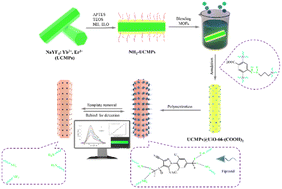
Fipronil is a broad-spectrum insecticide that is widely applied in agriculture, household, and public health applications. However, its abuse can lead to environmental pollution and endanger human health. Therefore, it is important to develop a simple and low-cost method for detecting fipronil. In this study, a novel fluorescence sensor for the detection of fipronil in the environment was prepared by combining molecular imprinting technology (MIT) with a metal–organic framework (MOF) surface modified upconversion micro-particle (UCMP) composite. The results showed that the fluorescence intensity of UCMPs@UiO-66-(COOH)2@MIP decreased linearly as the fipronil concentration increased in the range of 0.1–0.8 mg mL−1. Under the optimal conditions, the imprinting factor reached 3.01, and the limit of detection (LOD) was 0.058 mg mL−1. This method exhibits good specificity and quantitative detection capability for fipronil over a wide concentration range. At the spiked concentration levels of 0.2, 0.4, 0.6, and 0.8 mg mL−1, the recovery range of fipronil in water reached 82.04–90.73% with a relative standard deviation (RSD) of 2.47–5.18%, which indicates the potential of this molecularly imprinted fluorescent sensor for environmental detection.
 Please wait while we load your content...


