


 PLATFORM UPDATE:


Single-fiber versus macroscale electrodes: enzyme loading and impacts on bioelectronic applications in flexible biodevices
 a
Daniel S.
de Sousa,
a
Rafael N. P.
Colombo,
ab
Kamila C.
Pagnoncelli,
a
Rodrigo M.
Iost,
c
Luana C. I.
Faria,
a
Graziela C.
Sedenho
a
and
Frank N.
Crespilho
*a
a
Daniel S.
de Sousa,
a
Rafael N. P.
Colombo,
ab
Kamila C.
Pagnoncelli,
a
Rodrigo M.
Iost,
c
Luana C. I.
Faria,
a
Graziela C.
Sedenho
a
and
Frank N.
Crespilho
*a
Abstract
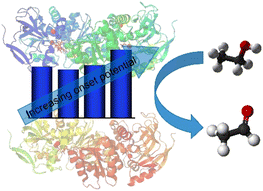
The integration of enzymes into miniaturised carbon electrodes is a central challenge in advancing flexible and implantable bioelectronic devices. Here, we investigate how progressive reduction of electrode dimensions, from macro-scale flexible electrodes to single microfiber configurations, affects catalytic performance in the ethanol bioelectrooxidation. Using alcohol dehydrogenase (ADH) as a model enzyme, we show that multi-fiber electrodes maintain high catalytic activity even after substantial size reduction, whereas single-fiber electrodes exhibit a marked decrease in current density and a significant positive shift in the onset potential. These results indicate that the spatial architecture of the electrode strongly influences enzyme loading and electron transfer efficiency. Our study discloses clear performance differences between macro- and micro-scale configurations, showing that the 3D architecture is a crucial factor when designing bioelectrodes. In this regard, our findings contribute to the literature by suggesting that specific immobilization methods are needed in order to produce highly efficient microbioelectrodes.
 Please wait while we load your content...


