


 PLATFORM UPDATE:


Optimization of fluorescence humification index calculation for low-concentration dissolved organic matter solutions
 *a
*a
Abstract
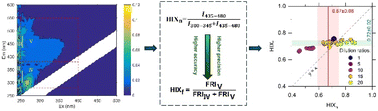
The fluorescence normalized humification index (HIXn), defined as the ratio of the fluorescence intensity in the 435–480 nm region (I300–345) to the sum of the intensities in the 300–345 and 435–480 nm regions (I435–480) at an excitation wavelength of 254 nm, has been widely adopted to quantify the degree of humification of dissolved organic matter (DOM). Nevertheless, in low-concentration DOM solutions (A254 < 0.3 cm−1), weak fluorescence signals at short excitation–emission wavelengths are susceptible to distortion by instrumental background noise, compromising the precision and accuracy of HIXn. This study systematically evaluates the effect of low concentrations on the reliability of HIXn using natural solutions and dilution experiments analysed via three-dimensional fluorescence spectroscopy. Dilution experiments revealed that as the dilution ratios increased, the precisions of both I300–345 and I435–480 decreased, resulting in a corresponding reduction in the precision of HIXn (CV ∼10.0%). In contrast, the fluorescence regional integration (FRI) parameters FRIIV and FRIV exhibited significantly higher precision (CV < 2.0%). Furthermore, strong correlations were observed between I300–345 (I435–480) and FRIIV (FRIV) (R2 > 0.95). These findings indicate that the FRI method can effectively replace sectional integration analysis, leading to the development of an optimized index (HIXf). HIXf not only significantly improves the precision (CV < 1.6%) even at low concentrations (0.3 cm−1 > A254 > 0.005 cm−1) but also increases the accuracy (0.72 ± 0.02, 2SE) by reducing the uncertainty caused by the inner filter effect. We therefore propose HIXf as an alternative for assessing the DOM humification degree across broader aquatic ecosystems and wastewater treatment systems.
 Please wait while we load your content...


