


 PLATFORM UPDATE:


Effects of Dynabead type, surface chemistry, and incubation on agglomerate behavior in dual-phase microfluidic systems
 *a
and
Ian G.
Foulds
a
*a
and
Ian G.
Foulds
a
Abstract
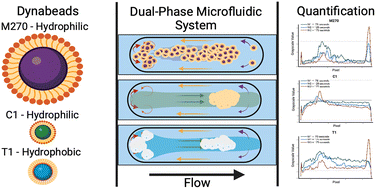
This study investigates the agglomeration behavior of streptavidin-coated Dynabeads (M270, C1, and T1) with different sizes (2.8 µm and 1.05 µm) and surface chemistries (hydrophilic and hydrophobic) when incubated with biotinylated bovine serum albumin (bBSA) in a dual-phase microfluidic droplet system. An automated dynamic inlet microfluidic (ADIM) system generates 20-droplet trains containing 1.6 µg per mL bBSA and Dynabeads. As droplets travel through PTFE tubing at 90 µL min−1, they are observed at three viewing windows corresponding to incubation times of 75 s, 125 s, and 175 s. A control experiment confirmed negligible agglomeration in bulk solution, indicating that the observed dynamics arise from the internal mixing of the droplet rather than pre-aggregation. Agglomeration dynamics are quantified using an image-analysis framework that includes a Front–Rear Intensity Difference (FRID) metric, a Band σ metric, and the standard deviation of normalized images. The results show that M270 and T1 beads exhibit rapid agglomerate growth at 125 seconds of incubation followed by redistribution toward the rear stagnation zone, whereas C1 beads display a slower, more gradual increase in signal without front-to-rear reversal. Two-way ANOVA and Tukey HSD tests demonstrated significant effects of both bead type and incubation time, as well as a strong interaction, confirming bead-specific kinetics and spatial redistribution driven by internal vortex circulation. These findings provide direct experimental evidence of vortex-induced particle transport in liquid–liquid droplets and provide insight into how Dynabead selection affects agglomeration kinetics, which is crucial for optimizing microfluidic assays and diagnostic applications.
 Please wait while we load your content...


